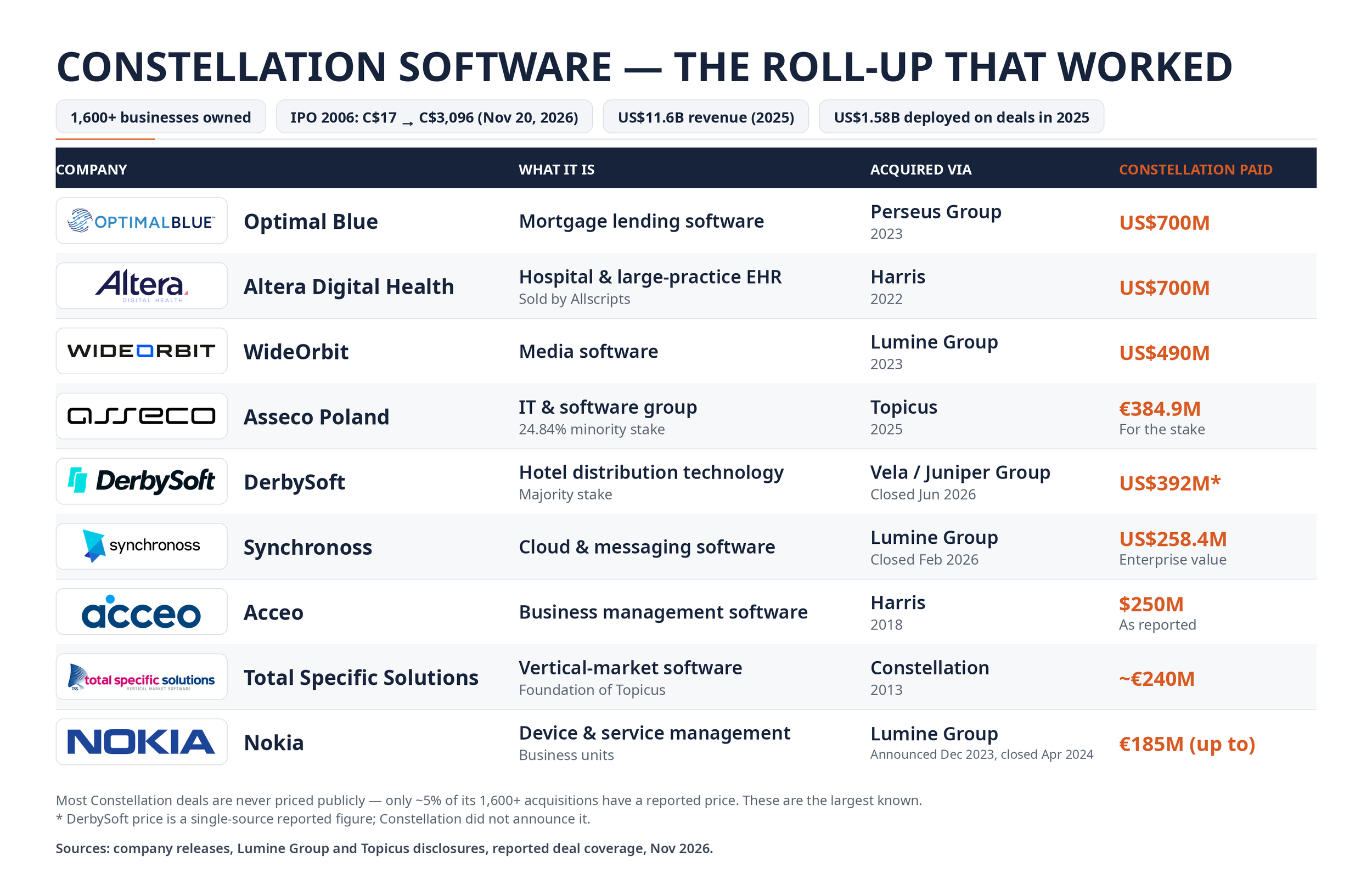
Mark Leonard built the most successful roll-up in history, and almost nobody can name a single company he bought.
Constellation Software owns more than 1,600 software businesses, acquired since 1995. Most deals are under $5M. Almost none are announced with a price. Only about 5% of its deals ever get one.
The stock IPO'd in Toronto in 2006 at C$17 a share. It closed Friday at C$3,096 and has never split. One dollar at the IPO, holding the shares spun out along the way, became roughly C$213.
Revenue was US$11.6B last year, built almost entirely by buying other companies, with essentially no new shares issued since the IPO. The share count today is the share count from 2006.
The buying rules never change. A database of roughly 40,000 target companies. Hurdle rates that historically started at 30% for small deals. Prices around 1 to 1.7x revenue while the private software market pays 3.4x.
Then comes the part nobody copies. After the deal closes, Constellation does almost nothing.
No integration. No rebrand. No synergy plan. The company keeps its name, its team, its office and its P&L. The founder usually stays and keeps running it. More than 80% of business leaders across its largest buying group were in place at acquisition or promoted from inside.
Head office is a few dozen people. It allocates capital, teaches capital allocation, and scores every unit on two numbers: return on invested capital and organic growth. Units that prove they can allocate get their own acquisition budgets and start buying tuck-ins themselves. With 1,100-plus similar businesses inside, any unit can be benchmarked against hundreds of peers. A standalone founder has a sample of one.
And nothing is ever sold. One business in 30 years. Sellers accept a lower price from Constellation partly because they know the company will not be flipped to a private equity firm in five years.
Leonard stepped down as president last year for health reasons. The stock then fell 56% as the AI panic hit software valuations. Under his successor Mark Miller, who sold Constellation its first acquisition back in 1995, deployment hit a record US$1.99B in the first nine months of 2026. The newest wrinkle is minority stakes in listed companies, about 25% of Poland's Asseco and roughly 13% of Sabre, a strategy Leonard now advises on himself.
Constellation bought the bottom of a thousand small markets with its own cash flow, then left them alone. Which model survives the AI repricing of software?
